Q&A with George Mendoza: Artist, Athlete, and Author of Journey of the Spirit Man

Updated: Jun 25

George Mendoza is an internationally recognized blind artist, author, and athlete whose life story is one of resilience and determination. After suddenly losing his sight at age fifteen, he went on to become a world-renowned painter whose vibrant, kaleidoscopic work has been exhibited across the United States and continues to inspire through its color and energy. In addition to his paintings, he competed in the 1980 and 1984 Paralympics as a runner, and later became the author and creator of the Spirit Man series, which consists of four books. The first in the series, Journey of the Spirit Man follows a young man who enters an
alternate reality and embarks on a spiritual journey through a series of symbolic worlds, confronting fear, guilt, ego, and ultimately discovering humility and self-realization. While fictional, the story draws upon universal spiritual truths and reflects many of the lessons George has learned throughout his own life.
Journey of the Spirit Man is being released as an audiobook, available for order here.
Buy the paperback here.

Your story is so unique in that you were born and grew up in a “sighted world,” as you call it, and then had to transition into an unsighted world. Can you talk about that transition, how shocking it must have been to lose your sight, and the process of learning how to interact with the world in a completely new way?
At first, I was very depressed, lost, and suicidal. I went from a basketball star to losing my sight over the next six months. But I discovered a talent for catching the basketball with my face! At public school, they called me a quitter, Batman, a freak, and four eyes. They were very mean to me. But, in a weird way, it motivated me to be the best I can be.
You attended Alamogordo’s School for the Blind and graduated in 1973. Can you talk a bit about your experience at a school for the blind, how it impacted your journey as both an athlete and artist?
My mother took me to the blind school. She basically dumped me there as if I were on my own, like other parents did with their blind kids in those days. I thought it was the end of my life as I knew it. I felt like I was being thrown away from society and into an institution. Everyone at the blind school was blind. At the school, I learned to adapt and adjust to my new world of blindness. At the school, I began to run again, took up the sport of wrestling, listened to talking books for the blind, and did many other things. I read novels, poetry, and true-life stories through audiobooks. I got back into shape by lifting weights and doing sports like swimming, wrestling, and running. I also learned how to paint, especially finger painting and sand painting.
How do you think accessibility in education can be made more prevalent?
The technology for the blind is really good. I can work on my books by using a speech system for the blind called Jaws. All my visual aids have speech. However, I have a hard time catching up with all these apps. They are very annoying. As a blind person, I have to catch up with all this new technology and more training.
You competed in the 1980 and 1984 Paralympics. Can you give us a glimpse into what may be different for you as a visually impaired athlete compared to sighted athletes?
As a blind runner, I would need assistance with a sighted guide. When I did run on my own, I ran into many obstacles and rattlesnakes, literally!
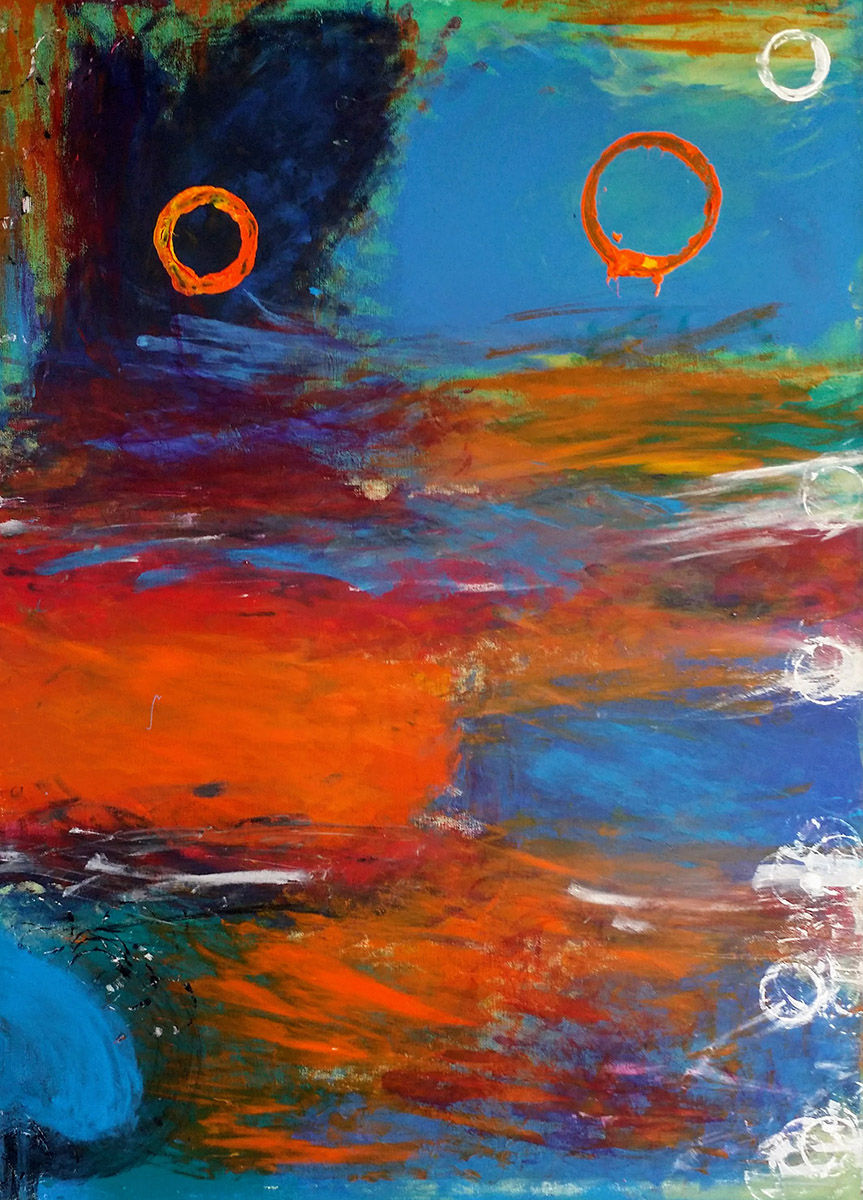
Many people assume that people who are visually impaired see only darkness, but your paintings challenge that misconception. Could you share how your work helps break down stereotypes and what you hope viewers take away from it? There are many different forms of blindness. In my case, I see dazzling colors, floaters, images of faces, flowers, and red blotches. I do not see any darkness at all! In other words, ironically, I paint what I see in my mind’s eye.

You have what some call “kaleidoscope eyes,” where you’re able to see shapes and colors in your vision. How has this contributed to your art, and can you describe how you’re able to translate what you see into art, despite your inability to fully see what you’re painting?
Ironically, I paint what I see in my mind’s eye. I got very good at it. Instead of seeing into the real world, I see deep inside the dream world of mine, which is there all the time. I can not see detail in the real world, so I paint whimsical images, which have made me very famous.
What have you learned about how the world perceives disability and the biases or prejudices that exist? How has your life experience shaped your understanding of how people treat one another?
When I first went blind, I was bullied a lot. Called names like quitter, Batman, loser, four eyes, or even blindy/blindo. I did not ask for any of this blind stuff, but I was thrown into the blind world. People think less of blind people. They bully the blind. I know of a physical therapist, a good friend of mine, who was born blind and regained his eyesight through surgery at the age of 24. He, too, was bullied when he was blind. He has PTSD from it. He has a ringback tone on his cellphone of the Country-Western song, “How Do You Like Me Now” by Toby Keith.
The unemployment rate for the blind is very high at 95 percent. Back when I was going blind in 1970, the job prospects were very discouraging, but it is better now with the help of new technology. However, the unemployment rate is still very high, around 70 percent. The legal system for the disabled and blind is like a circus with smoke and mirrors and a dog and pony show. Again, it goes back to the fact that people, by nature, tend to bully the blind just like in the animal kingdom. There is no justice in the courts for the disabled and blind. I feel like this has to change, and yet no politician has ever addressed this issue.
It’s been said that you have “eyes of faith,” meaning you see beyond the obstacle and into the dream. Do you have any current dreams or ambitions you want to achieve?
Yes, I have many dreams and goals! I am working on Colors of the Wind, an immersive traveling art exhibit. I am working on several more novels in the Spirit Man series. I am writing more children’s books. I have written two movie screenplays, and I hope to produce my books into films. I am currently producing a doc film, Spirit Man the George Mendoza Story, about my art and books.
The main character of Journey of the Spirit Man is a young athlete diagnosed with an incurable disease. Although fictional, the novel seems to draw on elements of your own life.
Can you talk about how you incorporated your personal experiences into this fantastical, superhero story? Did the process of writing it feel therapeutic for you?
The Spirit Man is me! I am a runner, and I went blind at fifteen, and there is no known cure for me in my lifetime. When I sat down to write my story, it was very therapeutic indeed.

I wonder how much of the novel is based on your life events. I was so surprised when Mark was stabbed. Is this fictional, or did you really experience this type of violence and grief in your own life?
Yes, Mark was based on a true story, but I changed his name. I just could not write down his real name in my story. We live in a violent world, and I can sense it all the time. I grew up thinking I would be drafted into the Vietnam War, but then I went blind. Maybe, in a weird way, that was a blessing. Instead of going to war and ending up dead or royally messed up in the head, I went blind instead. Makes me wonder how the future unfolds to reveal the past, and it is always 20/20.
You reference in interviews how The Wizard of Oz was an inspiration, and even quote it in the novel with the line “You’re not in Kansas anymore, Toto”. Can you talk about how this book/movie inspired you and what aspects you incorporated into your own strange, alternative universe that Michael finds himself in?
I read a lot of books. All kinds of books. I read all fifteen Wizard of Oz books. Did Dorothy really go to the Land of Oz? Did Michael really cross over to the other side and go through a magic gate and visit other worlds? I love that storyline. It is full of magic realism. As a blind poet, I wanted to escape my own harsh reality of being blind. So, I took my readers with me on this bizarre journey! Was it real? I don’t know!
Sometimes, if you think about it, reality has its illusions and perspectives depending on where you are and how you are thinking. For example, a rainbow is an illusion. Yet you can see it. But depending on where the viewer is located, the rainbow appears in a different location. And if you are in a high-rise building or airplane, the rainbow becomes a circle. That is wild!
One of my favorite aspects of the story was Michael’s journey through so many different realities in the new world. Each stop felt so distinct—from the barren desert and the nightmare-filled prison to the wish-granting paradise and ancient Egypt. How did you come up with these different worlds, and what did each one mean to you personally as you were writing them?
I believe in the power of imagination! As a world traveler, I have been to a lot of different places in the world. I used these places and experiences as locations in my book. From New Mexico to old Mexico to Canada to Europe and back again. Keep in mind, it is good to travel and see the world, or in my case, experience the world. It is said that the world is a book, and one who does not travel only reads one page.
There are a total of four books in the Journey of the Spirit Man series. How long did it take for you to write these novels?
Each novel is a stream of consciousness. Roughly three to six months for each book.
Can you talk about the writing process? Did you run into any surprises or unexpected challenges?
I would get up very early every morning and write for two to four hours. After the first draft, I would go over it again. Then I would hand it over to an editor for a second pair of eyes. The process worked!
What do you hope is the main takeaway from Journey of the Spirit Man, and the series as a whole?
Michael is a superhero who has to overcome many obstacles to reach his dreams and goals and survive in a hostile world, just like we have to do as humans in the so-called real world.
Looking back across your journey as an athlete, artist, and writer, what moments feel most defining for you personally?
Going blind at fifteen changed everything for me, and moving to New Mexico.
What advice would you give to young people with disabilities who are trying to find their path in sports or the arts today? Keep all your dreams alive! If you are going to be a runner, train hard and run! If you are going to be an artist, paint! If you are going to be a writer, write! Don’t be afraid to pursue your dreams! The worst tragedy is not to dream at all and never attempt to dream. Because you will never know if your dreams will become reality! Take risks, dream big! I have been interviewed all over the world. I am the Spirit man. I am Mr. Persistence! All I know is this, my sighted friends! Winners never quit, and quitters never win! Quitting is not an option! Never give up! Never quit! There is no sin in failure! The real sin is when you don’t try! As an artist, I have been rejected a million times, but I have also experienced a million and one successes! Dream on, baby, dream on!
Journey of the Spirit Man Discussion Questions
The novel opens with a prologue that immerses the reader in an eerie, dreamlike, fog-filled world. Why do you think the author chose to begin the story this way? How did this opening shape your expectations and influence your experience of the rest of the novel?
Throughout the novel, the author uses vibrant, colorful language to create an atmospheric and psychedelic experience for the reader. Can you provide specific examples of this language and discuss how it contributes to the novel’s overall effect?
Why do you think Michael blames himself for Mark’s death? Do you believe he was actually at fault, or is self-blame a natural response when someone loses a close friend? Explain your reasoning using evidence from the text.
Michael experiences two traumatic events back-to-back: losing his best friend and being diagnosed with an incurable disease. How do these experiences affect him, and how do they shape his character development throughout the novel?
The first strange reality Michael finds himself in after the desert is the prison of Gehenna, where each cell contains a person’s own unique hell, carefully designed around whatever would cause that individual the greatest suffering. What do you think this prison represents for Michael personally, and what might it symbolize in a broader sense?
Why do you think Michael chooses not to take revenge on Mark’s killer?
At the Holy Mountain, Michael effortlessly lifts the Cup of All Good Things, despite the nomads believing it cannot be done. What does this reveal about how perception shapes beliefs about possibility?
Why do you think Michael refuses the role of prophet, despite the power and ease of life it might provide?
In Paradisa, Michael is offered the chance to stay in a perfect world where every desire is fulfilled, and he operates at his highest potential. Despite this temptation, why does he ultimately choose to leave? What do you think would happen to him if he stayed?
In ancient Egypt, Michael is brought to a place of reflection and learning, where he is forced to confront his past self in the mirrors. What lesson does he learn in this stage of the journey, and why is this experience necessary before he returns home?
When Michael finally returns to his reality in Las Cruces, New Mexico, he uncovers a devastating surprise that changes the trajectory of his life. Did you expect this ending? How do you think Michael will cope with this news going forward?
Each alternate reality Michael experiences challenges him to grow in different ways. What are some examples of how Michael’s character changes from the beginning of the novel to the end?


Comments