Satire Novels, or Why Africa Can Be Funny Too

For #ReadingAfrica 2025, we have asked a few writers to write guest posts, recommending books from different genres. Feel free to join us over on social media for the weeklong celebration of African writing in all its forms.
By Alex J. Coyne
Satire is a genre that fits uniquely well into the African continent, where some of its issues have to be looked at through the looking glass of being funny or ironic – rather than issues like corruption, riots, dictatorial rule, and family squabbles being instantly perceived as horrifying, traumatic, or tragic. Satire provides a way to address difficult social and political issues/realities with humour and irony, rather than meeting them only through tragedy and or trauma.
The world’s most effective satire is able to take serious issues and examine them with a fair dosage of humour.
It’s part of the human experience, and both satire and humour have been credited with getting thousands of people through trying times – or sometimes with giving crucial issues a voice or an outlet.
Politics, healthcare, life, death, sex, relationships, love ... All these things can be looked at through the lens of satire. Scrubs made emergency rooms funny, though in reality, they aren’t – Zapiro comic strips turned the observation to popular culture and politics. All these things could easily be standard news headlines or library books, but satire turns them into something bitingly humorous instead.
If you’ve ever experienced life in various African contexts and cultures, you’ll know that there are many things (including power outages or political ideas) that eventually turn so bizarre that they become almost absurdist and humorous.
What happens when satire enters Africa?
Here’s our take on some of the best modern satire novels to take place on the African continent, and exactly what makes satire the ideal genre to give crucial issues a louder voice.
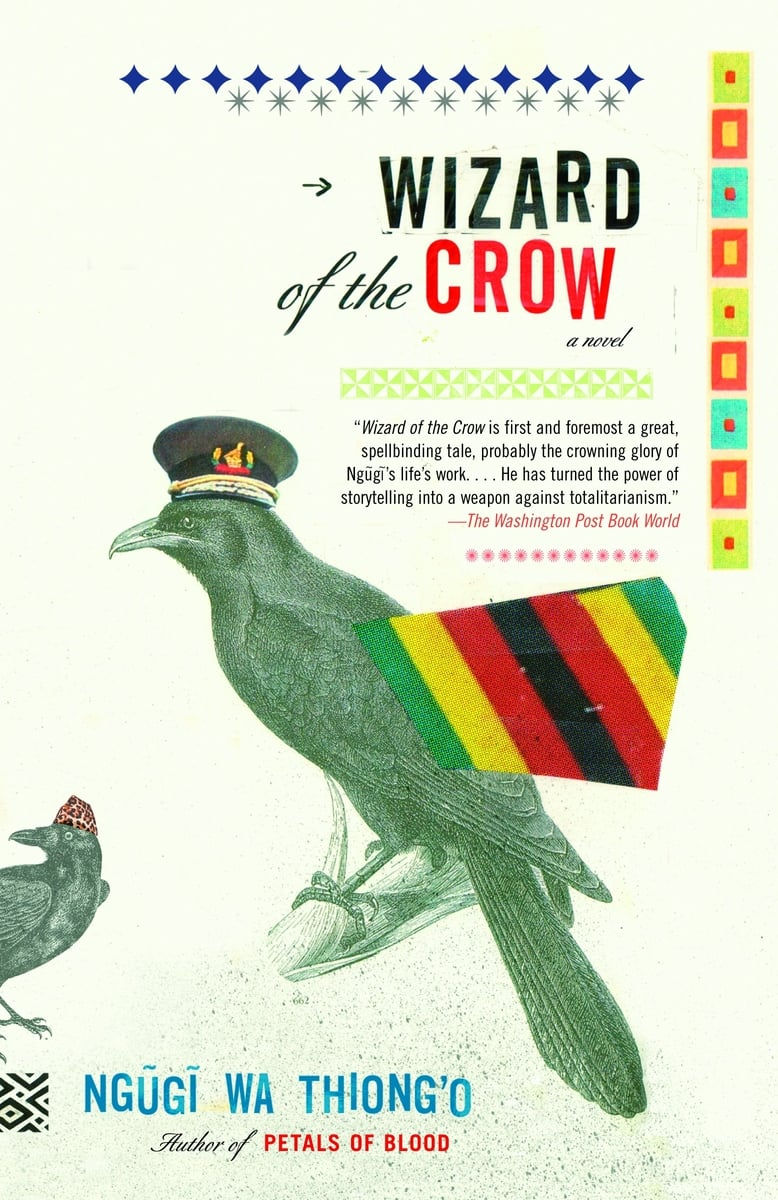
Wizard of the Crow (Ngugi wa Thiong’o)
Title: Wizard of the Crow
Author: Ngugi wa Thiong’o
Publisher: Penguin Books
Wizard of the Crow was written by author Ngũgĩ wa Thiong'o. They were born in 1938 and one could most definitely say that they aren’t a newcomer to the literary scene – even though the author might feel new to many after their work has been only more recently translated into English.
Wizard of the Crow was published in 2006, though was originally written in the Gikuyu language as Murogi wa Kagogo (2004).
The book explores a most bizarre premise that wouldn’t seem out of place in a real African country today, though takes place in the fictional Free Republic of Aburiria – which is simply described as set somewhere in Kenya.
Often the measure of great satire is that it sounds ridiculous as a premise or situation, but that it could also be very true in reality.
Wizard of the Crow suggests: What happens when an African dictator decides to build a tower of Babel? Moreso, how do people react to this display from a ruler who thinks he could equal himself to the gods?
The story explores rebellion and revolt in the face of corruption and bureaucracy, and the author has a great knack for blatant sarcasm and biting humour as in the below quote which humorously suggests queueing is a Marxist invention:
“Queues were a Marxist invention, according to the Ruler, having nothing to do with African culture, which is characterized by the spirit of spontaneity. Mass disorganization – pushing and shoving – was to be the order of the day…”.

African Psycho (Alain Mabanchkou)
Title: African Psycho
Author: Alain Mabanchkou
Publisher: Serpent’s Tail
African Psycho is an acclaimed novel that was considered a finalist for the Man Booker International Prize, and it’s clear from the first chapter why this book caught attention.
While satirical, African Psycho explores the darkness of the human psyche – and even though it uses humour to do so, the book takes on very serious concepts (including issues of personal safety, such as walking around at night or going out on a date).
The title is an obvious nod to Bret Easton Ellis’ American Psycho, and was first published in French (2003) before being translated into English in 2007. The novel also makes subtle nods to other books in the serial-killer and crime genres, and could have easily been a homage to the Dexter-series, too.
Criminal and aspiring killer Gregoire Nakobomayo is finding his way through life when he decides to plan his girlfriend’s death/murder. However, his inexperience is clear, and most of the book places him in the planning phase of his bizarre crime.
Like everyone’s favourite Miami blood splatter expert (and of course, serial killer) Dexter, the book succeeds in presenting Gregoire as a weird antihero that you should (but know you probably shouldn’t) feel some pity for.
African Psycho is a mind-trip through modern French-speaking Africa, and it can only be described as a bizarre take on how dark the mind can go. For any story, it’s pretty tough to go into the mind of a serial killer and still give it a humorous edge.

Brain Rot (Meki Nzewi)
Title: Brain Rot
Author: Meki Nzewi
Publisher: African Minds Publishers
Brain Rot is described by its blurb as “parody of the politics, in-fighting and corruption at a fictional university in Africa.”
The title alludes to the slang phrase “Brain Rot,” a millennial term that’s used to describe mindless entertainment, memes, or YouTube videos – usually ones that are believed to “rot the brain” through pop culture creations like the animated show “Skibidi Toilet.”
Brain Rot is a biting, academically-inclined satire that could only have been written by a professor.
Researching the author confirms it was written by Meki Nzewi, a lecturer of African Music, Theory & Practice at the University of Pretoria and co-founder of the Ama Dialog Foundation for African Traditional Arts in Nigeria.
If you have any family members who have worked in (or around) education, you might appreciate this book even more. If you don’t, then the book might recall your own experiences around teachers – who have to keep a straight face in front of their students, though while hiding a lot of administration and chaos behind their smile.
Brain Rot is about everything that’s generally swept under the carpet at educational institutions. This almost feels like a hilarious soap opera blended with a daytime comedy, and presented in writing.
There are scandals, affairs, and other things that go bump in the university halls. Students are scrambling and academics are panicking: you’ll feel like you’re getting a rare peek at what’s funny behind the academic curtain. Because you are.
Satire works because it’s a choice between tragedy and comedy. In this case, it’s a bit of both.

A Family Affair (Sue Nyathi)
Title: A Family Affair
Author: Sue Nyathi
Publisher: Pan Macmillan
A Family Affair pretty much tells you exactly what it’s going to be about in the title, and could be imagined as satire-meets-stand-up-comedy.
There’s a rhythm to stand-up comedy shows that many satire novels don’t replicate. Satire takes a situation and finds the humour, but stand-up comedy often draws the audience directly into the comedian’s personal sphere – and it’s funny to the audience because it’s hilarious to the comedian.
A Family Affair follows the Mafu-family, and is set in modern-day Bulawayo. According to its completely accurate description, the story “captures the complexities of family, culture, and the social constructs that surround women.” It feels like being drawn into a fictional family situation, and it’s funny especially because you’re following their stories and scandals from the inside-out.
Simply, they are church leaders and important community figures in charge of their church, The Kingdom of God, which serves as a religious experience, but also becomes necessary to run as the family business.
As the author of A Family Affair (2020) and An Angel’s Demise (2022), Nyathi is also a career analyst when not an author. And her unique, sharp insights about personalities and people are a clear trail through her work.
Just as Brain Rot offers sharp satire for people with family or friends in the educational sphere, A Family Affair is perfect for anyone who’s ever known someone who works for (or within) a congregation.
It’s simply a hilarious, fly-on-the-wall story that tells of families and their chaos; also a simultaneously satirical take about the weird tales that you will often find occurring within the walls of church management.


https://soicauxsmb24.com/ mình ghé thử vì thấy bạn bè hay nói, chủ yếu xem giao diện có dễ xem không. Vào trang cái là thấy họ để bài theo ngày khá rõ ràng, nhìn tiêu đề là biết đang nói đúng hôm nào nên đỡ phải kéo tìm mệt. Mình thích nhất là phần dự đoán XSMB hôm nay trình bày kiểu từng khối gọn gàng, đọc lướt vài phút vẫn nắm được ý chính chứ không bị chữ dồn dập. Màu sắc với font nhìn cũng nhẹ mắt, chuyển qua lại giữa các bài không bị rối. Nói chung cảm giác họ làm cho người xem nhanh, đặc biệt mấy box “dự đoán/soi cầu” đặt nổi bật ngay trên trang.